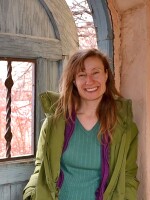
Dr. Wenjie Wang, associate professor and department chair of Early Childhood and Special Education, and Dr. Annabelle Black Delfin, adjunct associate professor, both with WNMU, published research on early childhood development after working on a multi-year project with little kids involving maps. Black Delfin is also the author of a recently published book, "Understanding Early Childhood: Paradigms, Theory and Foundations of Inquiry." KRWG's Susan Morée spoke with Black Delfin about the research, "Treasure Map Experience."
Susan Morée:
Annabel, you and your colleague, Dr. Wenjie Wang, did research looking into the cognitive skills of young children. What did you all find?
Annabelle Black Delfin:
Well, this is research that's ongoing, and we've had numerous papers published focusing on different findings. We're looking at the longer term trajectory of development over years during the early childhood years. Specifically, we're looking at symbolic representation. So we have crafted a project where we work with young children starting when they were three, and we followed them through their fifth year, when they are five-years-old. And we did numerous fun and playful activities with them using maps. And we chose maps because maps were generally a good artifact to look at how children either interpret symbols by using maps for, say, treasure hunting or how they use symbols and convey information when they make maps for other people to use and to see. So we've worked with this group for about six years now, and we've been parsing a lot of the data that we had. Our most recent paper that we just published in the Journal of Early Childhood Research focuses in on an aspect of map making. And what we noted were that children were increasing their use of symbols, obviously as they grew older and learned more, but we really focused in on something we called symbolic anchors. And these are attributes of a reference that are intentionally built into the symbol. So for example, if you're drawing a tree, you might build in the color, maybe brown for the trunk and green for the leaves, to give the viewer more information about what that symbol is conveying on that map. So we were really looking at how often and the frequency and the level of complexity that children were using the symbolic anchors of, specifically in this paper, color and shape when they rendered 2D graphic symbols.
Susan Morée:
And for parents who might be listening, what does this mean for them in terms of if a parent has a really young child between the ages of three to five?
Annabelle Black Delfin:
All of our work on the treasure map experience and Dr. Wang and my published papers are all grounded in something called sociocultural theory. And what that has, one of the basic principles in sociocultural theory has to do with is social interaction, that we as human beings are social creatures and we naturally learn from each other. And this is seen in the earliest parental relationships through more structured school and academic relationships and just all relationships in life. And so grounding our work in sociocultural theory, one of the big ideas in it is exposure. And so all of our work supports the idea that children who are exposed to a lot of vibrant interaction with other people, and not only people as people, but also all of culture, which is human constructed as well. So, having rich exposure to language and early literacy experiences, which are all based in symbolic systems, is really beneficial for helping with children's cognitive development as they acquire language, but also as they acquire literacy.
Susan Morée:
And if parents give kids a lot of map making activities, where they get to put visual symbols into the maps. Would that help improve their spatial reasoning and mathematical thinking, do you think?
Annabelle Black Delfin:
Yes, even just based on the idea of exposure to maps is going to start building a foundation of knowledge about maps. And I'm just using maps as one example. For us, we landed on it because it was kind of a way to build in fun activities to do with little kids. And that they would eagerly jump in and do it and also learn from it a lot. I've heard from many of the parents of the children in our research projects over the year, even recently as two weeks ago, where parents report back to me that their children's participation in these particular activities when they were three to five really set them up for understanding scale and distance, perspective taking, and in general being drawn to maps. Say they're traveling and they stop and they see a map on a roadside sign. Kids will point to it with more understanding than if they had never been exposed to it at all.
Susan Morée:
Okay, that's really interesting. And not only are you and Dr. Wang at Western New Mexico University, but you also, didn't you include a lot of Silver City kids in this research that you all did?
Annabelle Black Delfin:
Yeah, our research participants were at the Center of Excellence Child Development Center in Silver City, but also at the First Presbyterian Preschool in Santa Fe.
Susan Morée:
Okay. And did that difference in location make any sort of difference in terms of the kids' ability to create these maps?
Annabelle Black Delfin:
That's a good question. We didn't actually parse the information that way. We didn't analyze it along like say socioeconomic lines or any kind of racial or ethnic lines as well. We were simply looking at age groups.
Susan Morée:
Okay. And does this paper that you all publish, does it have anything to do with the book that you recently authored?
Annabelle Black Delfin:
Not really. The paper is part of the ongoing research project, the Treasure Map Experience. But I do have a book and it is more of a graduate level textbook on educational theory and how it is applied and implemented in early childhood. So that's a pretty different kind of topic. It has more to do with the philosophical outlook of the child care practitioner and how that outlook either of that individual or maybe a whole school or institution has a particular, is coming from a particular philosophical framework, say like Waldorf, for example, or Montessori schools. But that book is meant for teacher training. More explicitly, because it is a textbook. I guess I basically wrote the book I wish I'd had when I started graduate school, and we started talking about all these different philosophical concepts and how they apply to teaching and fostering development in young children.
Susan Morée:
Okay, well, thank you so much, Annabelle. I really appreciate your taking the time to talk to us.
Annabelle Black Delfin:
Great, thank you so much.