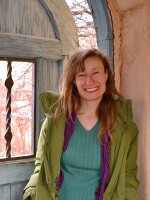
Hillary Pierce, producer of the documentary, The River and the Wall, spoke about the film which showed recently in Las Cruces. She also spoke about the border wall conflict in the Big Bend National Park and the surrounding area with KRWG's Susan Morée.
Susan Morée:
The documentary, The River and the Wall, was just shown here in Las Cruces. The film came out in 2019, I believe. What can you tell us about it and where can viewers find it if they missed it?
Hillary Pierce:
Well, the film is an adventure film about five friends who take a trip down the Rio Grande from El Paso to the Gulf of Mexico on horses, mountain bikes, and canoes. And the whole way there, they are exploring potential impacts of further border wall construction, some of which has happened since we completed and released the film in 2019. If you missed it in Las Cruces, you can check it out online. It's available anywhere you can rent or buy movies. And I believe it's also free on Tubi and Pluto.
Susan Morée:
And what can you give us, without giving any spoilers away, but can you give us a sense of what has been going on with the border wall and the Rio Grande?
Hillary Pierce:
Yeah, so there's been a recent push that started in February, that's when we first caught wind of it, to continue border wall construction along the southern border in multiple states. I believe it is President Trump's goal to have a border wall from sea to shining sea. Those are his words. And it's really heated up in the Big Bend region of Texas because of Big Bend National Park and Big Bend Ranch State Park, as well as a few other protected areas in the region. That's a really beloved space for not only Texans, but of course any national park lover, any outdoor enthusiast. And so border wall infrastructure construction could be very, very damaging to the environment in that area. So there's been a fight against it locally.
Susan Morée:
Can you give us a sense of some of what has been going on already environmentally?
Hillary Pierce:
Yeah, so they've already started seeking locations and prepping man camps, some of which could house over 600 workers. Those man camps require quite a bit of water. They've also been digging mines and wells for caliche [a calcium carbonate layer] and for water. This is all happening, of course, in the desert, so water, as any of your listeners know, is a precious resource, and we simply don't have enough to sustain the workers and the actual building of the wall and the roads.
Susan Morée:
And what about in terms of the long-term impacts? Wouldn't a border wall, is it actually in the middle of the river?
Hillary Pierce:
No, so the border wall is usually built further back from the river, which cuts off a huge chunk of land from people who want to recreate. And it also, of course, cuts off migration of various wildlife species and cuts them off from the only water source in the desert. So the environmental impacts are immense. Even in places where a 30 foot wall is not being built, roads and bollard walls, vehicle barriers, all of those things require quite a bit of ground disturbance and destruction of habitat. So it's really a bad thing, no matter how you cut it, for wildlife and the environment and the people who live here, of course.
Susan Morée:
And so the wall would cut off Americans on the American side from the Rio Grande. Is that correct?
Hillary Pierce:
That's correct.
Susan Morée:
That seems pretty amazing.
Hillary Pierce:
It's pretty horrifying, to be honest. Yeah, it's an unusual circumstance that the border between the United States and Mexico is defined by the deepest channel of the Rio Grande. But the solution that they've come up with to build this wall away from the river. You know, we're not only losing the river, but we're losing acres and acres of land. Thousands of acres of land.
Susan Morée:
And does it also affect private landowners as well?
Hillary Pierce:
Absolutely. Private landowners in this region in particular, as well as down in the valley and over the course of the last 20 years, to be honest, but more recently, private landowners have experienced trespassing and heavy machinery being driven onto their property without their consent. Those subcontractors have been told that they have the right to do that because these lands will be seized by eminent domain eventually. But the truth is they are trespassing and whether or not they are able to seize that land by eminent domain eventually, you know, it's not theirs now. So the prep work is illegal.
Susan Morée:
And you're also involved in the No Big Bend Wall movement. Can you talk about that a little bit?
Hillary Pierce:
Yeah, so No Big Bend Wall is a coalition that formed in the Big Bend region starting in February when we caught wind of the plans to build in this region. And it is a community coalition that consists of residents of the Big Bend. And we have representation from all of the small communities that comprise our regional community. And we are employing a number of tactics to stop border wall construction and to delay border wall construction. And that includes landowner support, as well as public information and education, along with a policy team. We have multiple committees that are dedicated to different avenues to stop this.
Susan Morée:
And has there been any success so far?
Hillary Pierce:
It's hard to say whether or not it's our efforts that have paid off or what exactly has done the trick, but we have been successful in holding off on some of this man camp development as well as dealing with the local water boards and trying to block access to water that would allow for border wall construction. So the public opinion has certainly been nearly unanimous locally and in the big cities. Everyone loves the Big Bend and, you know, Republicans and Democrats alike are against the idea of border infrastructure in this region.
Susan Morée:
And has there been any support at the state level in Texas?
Hillary Pierce:
There's been very little public support at the state level in Texas. We're hoping that more politicians will speak up and express their opinions about it. We believe that it's not a popular concept at many levels. So while we haven't heard from Governor Abbott in particular, we hope that the public pressure that we're putting on him and his colleagues will result in a change of heart and a change of plans.
Susan Morée:
It seems like this fight has been going on for a while, since the film came out in 2019. Is that correct?
Hillary Pierce:
Truthfully, it started long before that. There's been multiple administrations that have built border infrastructure along the southern border for many, many years now.
Susan Morée:
But not to, I assume, not to the scale that is currently happening?
Hillary Pierce:
Well, no one's tried it in the Big Bend. And because that area is a national park, as well as, you know, a series of other protected areas, both on the Mexican and American sides. It's just sparked quite a bit of outrage from lovers of the park and from local residents, as well as the private landowners that live adjacent to the park. That's just never happened in our region. So this is new for us.
Susan Morée:
And are there any sort of counter proposals out there about what sort of border security could be put in place in that area?
Hillary Pierce:
Yeah, there's been many over the years that various legislators have tossed out there and then gotten squashed. But within our coalition, we're actually working on some policy that we hope to share with legislators that does include some recommendations because we believe that border security can be achieved through much less invasive means.
Susan Morée:
Okay. Well, we look forward to seeing what those proposals look like when they come out.
Hillary Pierce:
Yeah, we'll be excited to share.
Susan Morée:
Okay, all right. Well, thank you so much, Hillary. I appreciate your taking the time to talk to me.
Hillary Pierce:
Thanks so much for having me.