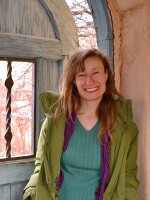
A young Silver City couple, Elysha Montoya and Nicholas Saiz, met on the Gila River, got engaged in the river and plan to wed there. They have also become advocates for the M.H. Dutch Salmon Greater Gila Wild and Scenic Rivers Act. This is a transcription of their conversation.
Susan Morée:
Elysha and Nicholas, you both just went to Washington, D.C. to advocate for the Gila River. Tell us what you did and why you're doing it.
Elysha Montoya:
We just recently went in March, and we got to meet with all of the members of the New Mexico congressional delegation. And our main purpose was to share our story on why this waterway is like so important to us. We, luckily in New Mexico, all of the staff and people that we met with are really supportive. So there was no convincing. It was mainly to remind them and to share the story from a local perspective of why this place is so special.
Susan Morée:
You're hoping that Congress will pass the M.H. Dutch Salmon Greater Gila Wild and Scenic Rivers Act. Can you talk about that?
Elysha Montoya:
So, we want we want them to pass it because once it's passed, it's protected forever. So it would protect the river from mining, dams, diversion. If it is protected and this passes, then it's pretty much forever that we would always know that all future generations are able to access the river. It'll look the same. It's preserved. And all the things that we get to experience there now with our children, all the future generations will get the same experience.
Susan Morée:
You two recently got engaged on the Gila River, is that correct?
Elysha Montoya:
Yes, we did.
Susan Morée:
And why did you get engaged there? That sounds really special.
Nicholas Saiz:
Well, the first time I had been to Silver City, I had met Elysha out on a hike there, just past Light Feather. And, you know, I was just exploring for my own reasons. And we had connected and we had started sharing more about each other. And, you know, we both have a son from a previous relationship. And that conversation is funny, too. It's because it was like, ‘Oh, I have a son, he's seven years old.’ And she goes, ‘Yeah, my son is also seven years old.’ I'm like, ‘Wow, what's his name?’ She says, ‘Kaylub.' And I'm like, ‘No way. My son is Caleb’. So ever since there and then in those conversations and being out in that part of the Gila, it's always been special. The Gila going all the way down to the Colorado has always been a special river for me. So, meeting Elysha and meeting a special person there, I definitely wanted to ask that question again there and, get all those same feelings. And yeah, it's just definitely a special place for us right up the middle fork.
Susan Morée:
And are you planning to get married on the Gila as well?
Elysha Montoya:
Yes, hopefully we are standing in the water when it happens.
Susan Morée:
Oh, that sounds lovely.
Elysha Montoya:
Yeah, I think we just need to figure out how to get our grandparents down there, but I think we'll get it done, yeah.
Susan Morée:
And talk a little bit more about the wildness of the Gila River and its flow.
Elysha Montoya:
Yeah, so it's completely untouched in New Mexico. It flows freely. It's one of the last free-flowing wild rivers. And so I mean, the way it looks now is probably the way it's looked for thousands of years. It's just this beautiful, remote place. You can see the stars. You can see every single star out there when you're in the Gila, and the canyon walls, every single curve of the river. It's really shaped through those canyon walls, and I think that, it's just special. There's nothing. There are no pipes running through it. There's nothing there that shouldn't be there. And I think that that's what we're hoping that we can just continue to protect this place. But with this act, I mean, it would just ensure that our kids, our grandkids and those after would just be able to have that same experience. I think that we were talking to the kiddos. When we told them we had to go to DC, and they just couldn't understand why we had to go. Because who would want to, why would anyone want to take that away? They've had all of these memories there. They know what it's like. And they just couldn't wrap their head around why a place like that is threatened, or [why there are may be some] wanting to destroy something like that. So I think that, in itself, was just huge and just shows that the children get it. And we're hoping that by sharing these stories that it just continues to be relevant and something that can pass this year.
Susan Morée:
Some parts of the Gila River are fairly inaccessible, correct? Because it's so remote?
Elysha Montoya:
Yes, yeah.
Nicholas Saiz:
And that's the beauty of being at the headwaters and in the Gila. It is so remote, and if you do hike up, you'll see huge sycamores. You'll see nature in its balance. The river is flowing, the trees are growing, the birds are chirping, everything is so alive there. You'll see butterflies, hummingbirds, dragonflies, you know, everything that just kind of makes you feel a little bit more special being out there. And I grew up out in Sheldon, Arizona, and that's like right on the border of New Mexico and Arizona. And this time now the river will dry up down there. They have plenty of farms and diversion dams that take some of the top water, but it continues to run underground. So when we would go fishing, we would have to find the riverbed and then either walk upstream or downstream when we were younger. So being up here at the headwaters, you see it flowing year round. You see it just in its natural state. And that's just truly a blessing and something we need to protect for future generations.
Elysha Montoya:
And we also just think if it were to be dammed or diverted on our end here in New Mexico, the people who live out in Arizona and Nick's family, they would have no more Gila. It wouldn't flow the way it does when it does. So that would even be all of the people, even on the Arizona side, wouldn't be able to, enjoy what they've been able to, [what they] grew up with. And it's just super, a very special river.
Susan Morée:
And the Gila still flows most of the year, correct?
Nicholas Saiz:
Up here at the headwaters, for sure. It's always running.
Elysha Montoya:
Yes, I would say throughout New Mexico, yes.
Susan Morée:
I know you said the New Mexico congressional legislators were in alignment with your goals, but what about the rest of Congress? What's the outlook like for this bill to pass?
Elysha Montoya:
So, I know that recently, we were able to get the bill endorsed by the Hispanic Caucus, which was really great news to hear about that. And, you know, I can't say much about the rest of Congress. I mean, I think if there's any questions, I would hope that they, personally, I would like to invite all of them out here just to experience it before any decision is made.
Because I think once you step foot out there, you can really see why this is special, why this should remain. And I think it touches everyone differently. I think everyone has their own unique experience out there, but I think that the way you feel whenever you leave, and whenever you're just sitting in the river and staring at the stars or just out there, I think that feeling is something that there's not many places that you can still feel that way. You can just exist freely. You don't have to pay to be there. This is a place that's free for everyone, and it's a place that brings these types of…I think my son said earlier, I said, ‘What do you feel when you're in the Gila?’ He said, ‘Relieved.’ And I mean, I can't think of a better word, relieved, natural, and it's just how it should be. And I can't say much for the rest of Congress. I just hope that they make the right decision and that they see how much it means to us locals. This is our natural resource. It's in our backyard. And it's something that we look forward to. And this is, from my memories growing up to Nicholas in Arizona, and this is now something that we share with our kids. And there's so many people like us. We're not the only ones. Sometimes it's hard to find a spot on the river, but if you hike out far enough, you'll get there. So I think just the fact that it's just special to all of us who are here, and we would hate to see anything happen to it. It just needs to be kept the exact same way it is, and it's something that we need to protect.
Susan Morée:
Okay, thank you so much for taking the time to talk to me.
Elysha Montoya
Yeah, of course. Thank you.