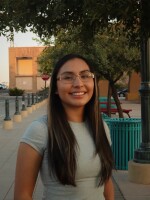
Abigail Salas:
Can you tell us about how your background has prepared you to serve as sheriff?
Gabriela Lozano:
I initially started as a 911 emergency dispatcher. That's where I initiated my public safety career. I started back in 2016 and from there I just fell in love with public safety. After that, I stepped into a leadership role at the dispatch center as a union president where I learned a lot of the administrative work that it takes to kind of look after working families or fight for working families, really. After I left the dispatch center, I went on to work at NMSU with governmental affairs where I learned to lobby on behalf of the students. And then now I work as an intelligence analyst where I serve alongside local, state, and federal agencies. And I do all of the intel work across the state of New Mexico alongside a team of people. And so, I think that experience all on its own, I see the sheriff's position more as an administrative role. And I think having the roles that I've had have allowed me to see public safety from different angles. So, I think that it has given me a well, it has shaped me well to to be able to give me the skills needed for that position.
Abigail Salas:
And why are you running for sheriff?
Gabriela Lozano:
I think we need a different perspective to leadership in that role. I think everybody, traditionally we believe that it needs to be somebody that's always been an officer or always been a cop, but really the sheriff's job is an administrator. Somebody that does understand public safety, but that has strong administrative skills. And not just that, but that also represents the communities. You don't just represent the law enforcement community, you represent the people of the county of Doña Ana County. It's really it. Like I really think that you need that, we need somebody that's got a different perspective of what law enforcement is and what community needs and people really.
Abigail Salas:
What are the top issues in the county and how would you successfully address those issues?
Gabriela Lozano:
I think some of the biggest concerns that I've seen or that I've heard from are one being juvenile crime. Another I think is just the relationship between law enforcement and the public. And I think speaking on those two, juvenile crime is hard to manage. I hear everybody talking a lot about prevention and how we need to incorporate organizations or incorporate the community, get into the schools. And although I agree with that entirely, and I'm a huge supporter of that as a mom of a teenager myself, I think we need to be very proactive in crimes. For example, I mean, gun crime is huge in juveniles right now. We need to really target like where are they getting these guns from, you know, and collaborating with other agencies so that we can put a stop to that across the state. As far as the relationship that the trust that's there from law enforcement from the public to law enforcement. That's another one that I think people just don't feel connected to what law enforcement is really doing. However, on that same thing, we don't have a lot of officers right now. There's the bandwidth is so low, and I think that that's also a community concern, and I think that those are things that we have to progressively address.
Abigail Salas:
Technology is rapidly advancing the footprint of law enforcement. What technology that exists now in DASO would you expand upon and what new areas would you develop?
Gabriela Lozano:
Right, I mean, so absolutely, if there's funding available for us to expand on those things, we'll more than, I'd be more than happy to expand on that and bring all of that into the sheriff's office. We have to have the funding for it too though, or we can collaborate with our agencies as well. I would be happy to work alongside Chief Story to get some guidance on how he's established all of these, where he got the funding from, how he went about it so that I could go in there and seek that same support for the sheriff's office.
Abigail Salas:
The training budget for DASO is about $100,000 a year. Would you expand or contract it and why?
Gabriela Lozano:
Absolutely, I mean, if the opportunity is there to expand the training budget, we would expand. I believe wholeheartedly that training is extremely important and it allows, we always talk about education, education, education. And that's one way. I mean, you can't expect your deputies or your team to be up to date with what's happening out in the community or even across the country because what happens across the country affects us also at a local level. I have great partnerships. I'm a member of the New Mexico Narcotic Officers Association. I've, you know, have through my employer, we have close connections with Arizona HIDTA puts on phenomenal trainings. New Mexico HIDTA puts on phenomenal training that our officers can be a part of. I mean, we would expand wherever we can. If there's funding and I can apply for it, I'll be the first in line to do so.
Abigail Salas:
What role in budget preparation, presentation and monitoring do you see yourself in at DASO?
Gabriela Lozano:
Probably one of the primary roles to ensure that we're applying for all funding that's accessible to us or that's available to us. And I would say that I, a good leader, monitors specifically that, the finances of things, right? I mean, you don't have to, of course we would delegate the task to somebody that has specific experience in that, but I could tell you that firsthand I would. I want to oversee that. I want to bring as much funding into the sheriff's office as possible to ensure that opportunities are open, not just for recruiting, but for retaining our current employees that are there to show them that they're appreciated. My experience in as a union president, I negotiated the contract for the 911 emergency dispatch center. And I would say that the team did really well. We secured quite a bit of money for the working families there at the dispatch center they had. a very significant raise and I plan to execute that same accomplishment for the sheriff's office and to work alongside their union so that funding can be distributed across the board for everybody.
Abigail Salas:
And what else do you think is important for voters to know about your campaign?
Gabriela Lozano:
Well, I think one of the biggest things is I'm not, I don't have the traditional experience that my counterparts do or that my opponents do. All of them come with 20 some years of experience, you know, working out on the streets. I don't do that. I've never done that. I've worked beside them as a dispatcher and now working intelligence. My role has been very different, but I bring a different perspective to things, a different perspective to leadership. I plan to work very hard for this community. I'm from this community. This is my home. So, I want them to know that I come with a humble mind to learn and to lead them with as much integrity, with all the integrity that I have.