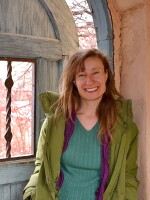
For Books on the Border, KRWG's Susan Morée spoke with Kelly Krumrie, assistant professor of creative writing at NMSU, on her latest novel, Concentric Macroscope, and what inspired it.
Susan Morée:
Kelly, you've written this novel called Concentric Macroscope. First, let's get started by telling us a little bit about just what the novel's about.
Kelly Krumrie:
Yeah, so the novel follows a linguist who, in her past experiences, has focused on the project of constructed languages, or sometimes called invented languages, where you make up a language, something like Klingon or Elvish or Esperanto or famous ones that we know. That's her expertise. And she's been working for this agency who put her in contact with different linguistic projects. So the book begins with her starting at a new project where she's been sent to this hills, to like the top of a hill where there are these huge looming radio towers. And she's alone, she's isolated there, and she's told that she needs to construct a language to send a message through the towers. But that's all the information that she's been given. And it's very secretive and experimental. That she doesn't have any information about kind of what's going on, and that's part of the project. And so the novel kind of follows her as she's thinking about what to do and working with various mysterious colleagues on this site. And it kind of muses on language, how it works, why and how she got there, and her kind of, I guess, thoughts and feelings about being stuck up in that space.
Susan Morée:
The novel felt to me sort of like a marriage of speculative fiction with literary fiction. Is that something you were trying to explore?
Kelly Krumrie:
Yeah, I think I would agree with that. And I think that kind of marriage is something I've been interested in for a little while. And the book right before this, which is called No Measure, is a book-length series of short prose fragments with a similar isolated workplace experience going along with it. I thought that one was going to be like a kind of sci-fi novel, and it ended up not being that way. And this one I went into it being like, okay, I'm going to write like a kind of sci-fi novel now. And it kind of, I think it touches on aspects of that, but doesn't go kind of all the way, which is something I really love about speculative fiction versus something like full-on sci-fi that it kind of dances at these edges of reality and dances at these edges of genre.
Susan Morée:
I find that kind of interesting because you have a PhD in creative writing and writing programs tend to focus more on literary writing and, at least in my experience, can be kind of snobby about what we call genre fiction. Was this a sort of rebellion against that?
Kelly Krumrie:
I don't know. I think it'd be hard for it to be that way because, well, for a couple of reasons. I think that is true that those types of programs tend to focus on, you know, like a lot of research and literary theory, right? Like very heady level stuff. And this book does engage with the philosophy of language and linguistics and some of these technical ways that language works, which is definitely coming straight like right out of my PhD work and even some of my other academic scholarship. So I was doing some of that research alongside writing this book. But I don't know if I would call it a rebellion so much. Like thinking about how I could play with, maybe temper and play with some of those more serious academic concerns in a way that's mysterious and palatable and, you know, makes suggestions towards things like outer space communication. There's like a lot of Contact, like the Jodie Foster movie Contact, like very large array kind of energy, I think, permeating throughout the book without sacrificing the literary components.
Susan Morée:
And one thing I think the reader can't help but notice right away when you first open the book is the fractured structure of the narrative and it felt to me very collage-like and it put me in mind of some of Jenny Ofill's work or Maggie Nelson's Bluets. Did you have those works in mind or what were you thinking in terms of your fractured narrative?
Kelly Krumrie:
Yeah, I hadn't at the time of writing it. I'm familiar with the work of both of those authors, but I had never read. I actually still haven't. I'm going to be embarrassed to admit that. Other people have made that connection as well. And I got Jenny Offill's Department of Speculation right after someone else made a similar observation, but I haven't had a chance to dig into it yet. But originally, I mean, I do love fragmented narratives. I love thinking about the spaciousness on the page and more collage-like fiction is what I'm drawn to as a reader. And so thinking about, I guess, there's that Toni Morrison line of write the kind of book that you like to read. And those are the kinds of books that I really like to read. So I'm writing for myself and kind of entertaining myself and having a fun time as I'm messing around. So what the fragmented style is for listeners. It's one sentence at a time. So it's one sentence space break, one sentence space break, one sentence space break for the entirety of the book. And that started because I was messing around with working with some sound artists and reading a lot about vibration and resonance and the various mechanics of our auditory world. And I just started writing a sentence about describing a sound. And then I wrote another sentence trying to describe a sound. And then I wrote another sentence trying to describe a sound. And then I just had this list of sentences and I started thinking about like, well, maybe these are kind of more like vibrations than they are like a paragraph, you know? And so I started thinking about how I could keep each sentence as this like ring that either like calls back to the sentence before it or calls forward or forms this kind of repetition. So I started thinking about that initially. And then as I kept going and as radio and communication and series of communications started and secrets, I guess, sort of kind of coming into play in the book, I was thinking a lot about the notion of call and response with how the space between the sentences was working. Like if I send a message across the telegraph wire, you know, that space break is running along the line or the time it takes, you know, to send a message to communicate to somebody else. So it started that form started working on multiple levels for me as I kept writing, and it helped me think about what would happen next in response to how that form was operating.
Susan Morée:
I saw it as a metaphor, a sort of larger metaphor for the fractured way in which we communicate or the ways in which we fail to communicate with each other. Is that?
Kelly Krumrie:
Yeah.
Susan Morée:
Would you agree with that?
Kelly Krumrie:
Yeah, 100% I would agree with that. You know, and another reader early on, I think it was one of the first interviews I did for the book, a reader noted that they were thinking of those sentences as rungs of a ladder or like the metal bars that go up the pylon as you're looking at it. And at one moment, the narrator does climb up the pylon and she sees other people climbing up the pylon. And I was like, 'Oh, it does look also like ladder rungs.' So I like that as well. I guess it's another kind of, maybe like concrete manifestation of the form.
Susan Morée:
And did you get to climb up a radio tower?
Kelly Krumrie:
Oh, no. I mean, I've definitely hiked up many a hilltop to look at them up close. I have, and just to listen and feel the wind. And then you can also often hear buzzing, right, or something happening with it, many of which are like, fenced off and then have all these kind of little outbuildings. So both in New Mexico and in Colorado where I was living when I was just starting the book, I did do a lot of field trips to those types of spaces. But no, I haven't climbed up. I think I would be way too scared because I'm scared. I'm afraid of heights.
Susan Morée:
And the title is a little bit of an enigma, I think. It's called Concentric Macroscope. What did you hope the reader would interpret from that title?
Kelly Krumrie:
I think it's kind of a little puzzle of a title that I think, in thinking about what it could possibly mean, like while, I mean, concentric invoking concentric circles, which for the book are a vibration, which the narrator mentions the concentric circles of a vibration over and over again. And then a macroscope is a mysterious word I learned when I was doing some of my sound studies research in support of this book, which is just kind of, you know, like the opposite of microscope, right? Like seeing this big expansive view. So I think I was, you know, I was originally imagining just like this recursive pulsing, like a big pulsing eye. I think of and maybe that I hope people will maybe come to. Because of that, the way the sentences are in the book and I think maybe more part of the collage or literary structure of it is that a lot of things recur and time and space are kind of happening like simultaneously throughout. And so I think that macroscopic vision, which feels delightfully impossible, is kind of what I hope people will think of.
Susan Morée:
Okay, well, thanks so much, Kelly.
Kelly Krumrie:
Yeah, thank you so much, Susan.
Kelly Krumrie will read from her novel, Concentric Macroscope from 4:30 to 6 p.m. on November 18 at the Branson Library Lobby in Branson Hall, 1305 Frenger St (also referred to as Frenger Mall), Las Cruces, NM 88003.