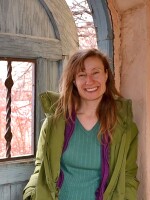
Sarah Hurteau, director of resilient cities program for Signal and Mike Gaglio, owner of High Desert Native Plants LLC, speak with KRWG's Susan Morée about a recent report highlighting how nature-based solutions could be the future for solutions for New Mexico's climate change issues.
Susan Morée:
New Mexico is facing a future with less water and you all are involved in nature-based solutions. What does that look like and how can that help with these ongoing mega drought issues that we have?
Sarah Hurteau:
Yeah, so the idea of nature-based solutions, it's an umbrella term that we use to describe a lot of practices on the ground that essentially use nature as the force behind improving water quality, capturing rainwater where it falls, reducing erosion, and creating healthy forests and healthy soils. And so, there are many, many practices that fall under the category of nature-based solutions, but these provide a lot of tools for us to tackle some of the challenges that we're facing in New Mexico and throughout the desert Southwest. So, things like wildfire and flooding and drought, these extreme events, the traditional infrastructure that we have been using can no longer meet these extreme weather events alone. And we need to be incorporating nature-based solutions to help us manage these situations, prevent some of the damage that's happening and help us recover faster and more effectively and more cost effectively.
Susan Morée:
And Mike, you are involved in rainwater harvesting. What does that look like and how does that help with drought?
Mike Gaglio:
So rainwater harvesting is basically capturing rainwater either passively or actively and directing that rainwater to a place of safe and beneficial use. In our work, we really try to promote rainwater harvesting because we want to keep as much water that lands in our watershed, we want to keep it in our watershed. And we do that by installing earthworks and passive rainwater harvesting features that allow rain to soak into the ground where it lands and where it falls. And another way of doing rainwater harvesting is also through active rainwater harvesting, which utilizes tanks or rain barrels so that a homeowner, for example, can store that rain and use that water for their plants or their garden at a later date. I prefer to start people with passive rainwater harvesting because it is usually less expensive and we can effectively store and put much more water in the ground than we can store in tanks. And once that water has soaked into the ground, it's available for the plants and the trees in the ecosystem to utilize that water and that's what it's needed for. So that helped with a whole bunch of different urban and rural aspects in wildlands.
Susan Morée:
Climate change has caused so many problems in our environment and it frankly seems kind of overwhelming. These nature-based solutions seem sort of small. Are there enough projects out there to really make a difference or what are your thoughts on that?
Sarah Hurteau:
I'll take a stab at that first and then Mike, maybe you can add in some of the local work that you're doing. So, the idea is that these are scalable to the size of the problem. So yes, they can be small and in many cases, we are talking about small distributed features because particularly for green stormwater infrastructure in urban environments, it's much easier to clean and infiltrate into the soil small amounts of water than it is large amounts of water, right? So, for example, if you're capturing the water off your street or off your driveway to water your tree, then that's much easier than having a hundred or a thousand houses in a neighborhood having all of their water being treated at the end of the neighborhood. So as Mike said, capturing it where it falls in these smaller distributed network of features really adds up to large impacts, particularly for watering street trees, and native vegetation and creating that sort of oasis feel that allows cities to have greater walkability. You know, here in New Mexico, we all like being outside, but there's a lot of days now that it's too hot to be out there. And so how can we use stormwater as an asset to repurpose it for creating that oasis feel and maintaining the quality of life that we all desire here? And that has a general impact on the water quality. So, stormwater runoff in urban environments is the number one pollution source to the Rio Grande. And so that is really important because these small distributed features really add up to improve water quality for our river and our wildlife habitat. So, these are practical things that people, that everybody can do that contributes. And it may seem small, but when you add them all up together, they make a big impact.
Susan Morée:
And did you want to add something, Mike?
Mike Gaglio:
Yeah, well, thank you. Yes, I'll start with echoing what Sarah said is that rainwater harvesting features and nature-based solutions are scalable to the environment that you're working in. So, a homeowner can do a small curb cut or a small rainwater harvesting basin in their front yard, but then from an urban perspective, the municipality can incorporate green infrastructure in all kinds of different spaces around the area. It is one of my philosophies that every landscaped space in the built environment is an opportunity for green infrastructure. And so, what that means is that pretty much anytime you see a little landscaped area within a parking lot or a median in a street or the parkway between the street and the sidewalk and then the little landscape space between the sidewalk and the parking lot, all of those opportunities are there for capturing stormwater if we design our spaces to allow that to happen. And by capturing stormwater, at least some quantity of it in these spaces, we can reduce the amount of and the severity of the stormwater going down the street and causing erosion and problems and pollution further downstream. Like the Sandhill Arroyo project, so in that case, what we did was we're looking at neighborhood scale and watershed scale restoration strategies to capture sediment within an arroyo that runs between two neighborhoods in order to slow down the water and reduce the amount of sediment pollution that's getting onto streets and eventually down into the Rio Grande. So we installed several features within the arroyo that scale up to the size of the flows within the arroyo. And as we all know, the arroyos can really, really flow strongly during big storms. So yes, these features are scalable to address the problem.
Susan Morée:
Are there more proposals out there that just aren't getting funding?
Mike Gaglio:
Yeah, probably. There are some that are funded. We're currently working with some organizations to do watershed restoration features further in the uplands, kind of out in the ranch areas. We're working with the BLM and the State Land Office on some grazing leases out in Doña Ana County to do erosion control, nature-based solutions that aim at erosion control. And I'm sure there's others. I know of some projects that are working on getting funding in the, also in the city. And of course, for every project that does get funded, I'm sure there are others out there that don't get funded.
Susan Morée:
And just briefly, what is the Sand Hill Arroyo Green Stormwater Infrastructure Project? What did it, what problem did it solve?
Mike Gaglio:
So that project, the Sand Hill Arroyo Green Infrastructure Project took urban stormwater runoff and slowed it down within the arroyo, spread it out, and aimed at adding more vegetation so that erosion is stopped. So, we're basically stopping the flow of erosion down the stream. Erosion, Sarah, help me with the technical things here, total dissolved solids. And erosion is one of the reasons why the Rio Grande is considered impaired, according to Texas water quality, or I'm sorry, New Mexico water quality law. And so, by slowing that erosion down, we hold that sediment back on the site and we keep it back and trap it in there. And so, then when water does leave the site, that water is cleaner.
Susan Morée:
And where is the Sandhill Arroyo?
Mike Gaglio:
That's a good question. I get lost every time I'm on my way out there. It's on the northwest side of Las Cruces and it goes underneath I-25 and between the south of the Doña Ana exit. So, I think it's just south of exit 9, between exit 6 and 9 there.
Susan Morée:
Sarah, why create the report?
Sarah Hurteau:
Yeah, so what we were noticing was that there's a lot of people that are doing this work in New Mexico, like Mike and myself, you know, Signal has lots of these projects throughout the state as well. Green spring water infrastructure and urban forestry is another sort of approach to nature-based solutions working in cities. And what we noticed is that there were a lot of people on the ground that were doing this work that we didn't have enough funding for the projects. You were talking about unfunded projects earlier, and there are many, many, many of them. An example of that is the New Mexico Legacy Fund. So, there was something like $50 million worth of projects that were proposed and unfunded because the projects proposed out weighed the amount of funding that's available for this kind of work. And so, what we were looking to understand is how can we understand the barriers to how funding is flowing through existing state programs and provide recommendations on how to improve that situation. So more of the money that the legislature is putting towards nature-based solutions actually makes it on the ground to these projects and identifying those opportunities both legislatively and in the executive branch and in the agencies themselves, where could we make progress under their existing authority to change the situation that improves the money flow for these really great projects that need to happen. Okay, because many of the nature-based solutions are seen as critical infrastructure and so particularly rural communities are counting on these nature-based solutions. For projects, but there's a money mismatch in what that money can go towards. And so, part of it is a terminology and language barrier. We're not all using the same language to describe what nature-based solutions are and what these practices are on the ground and how that translates through, you know, when agencies put out solicitations for projects, the criteria by which they're evaluating them and the terminology that they're using for eligible practices. And so, there's a bit of a mismatch there. And so, that's one of the things in particular that we're hoping to resolve through ongoing discussions with the legislature and the agencies to understand how we can fix these things.
Susan Morée:
Is there anything else I haven't asked that you all think I should have?
Mike Gaglio:
I don't have anything specific, but I do have a comment about the terminology. And yeah, I think it's interesting. We do need to, we do kind of all need to get on the same page with the terminology because and forgive me, I'm actually trying to find the words myself as we're talking about terminology, but nature-based solutions in many ways deal with managing stormwater. However, as you can tell by the words nature-based solutions, we've gotten away from calling it stormwater management. And the reason for that is because we are doing more with that stormwater management than what those two words imply. Because we're adding shade canopy and we're restoring processes that were taken away as a result of the built environment, as a result of construction of the built environment. We lose things like wetlands and other natural features that provide all of these ecosystem benefits. And that's part of the challenge is that it's so many words to describe so many things that happens with water in a natural system. So, to call it rainwater harvesting is too simplified. To call it stormwater management involves, you know, invokes the idea of gray infrastructure, pipes and ditches. To call it green stormwater infrastructure especially in the desert, implies something that it actually may not look like. So now we're calling it nature-based solutions because by managing water in this certain way, we can provide all of these ecosystem services. However, I actually still think that that kind of does a little bit of a disservice to it when really what we're doing is planting the water and I wish that there was an easy way for people to understand the importance of the ecosystem service that's provided by keeping the water in the watershed. It's so complex and so esoteric, but yet so basic and so necessary.
Susan Morée:
Okay. Well, thank you so much. I really appreciate your both taking the time to talk to me.
Mike Gaglio:
You're welcome. Thank you.
You can read the report here.