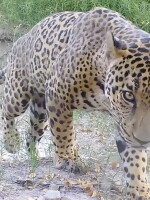
Cuenca Los Ojos Conservation Director and Silver City resident Peter Winsor talks about rewilding and restoration work at Cuenca Los Ojos in northern Mexico.
KC Counts:
Tell me about Cuenca Los Ojos and what kind of work it does.
Peter Winsor:
Yeah, Cuenca is, it's interesting because, no, I come from I have a science background and went into conservation later in my career. And I was the director for World Wildlife Fund, their Arctic programs. I worked a lot with big areas such as Arctic, Antarctica, worked with polar bears and caribou and different species. And when I moved down here to New Mexico, I heard about this Cuenca Los Ojos Reserve, which was south of the Sky Islands region. on the Mexican side of the border and was really curious. I heard that it's doing novel things in rewilding and restoration. And a friend of mine in Silver City here where I live connected me with the current executive director, Valerie Gordon, who invited me down. And I went down there on really beautiful sunny day. And Valerie took me around the reserve for a couple of days and I absolutely fell in love with that landscape and the amazing biodiversity that we find down there. And I was like, this is some of the most promising landscapes I've seen in my whole career. So I'm like, I want to work here and help out and do whatever I can.
KC Counts:
What made it so promising?
Peter Winsor:
I think many things. I think just the high biodiversity itself, how beautiful it is. There's very big mountainous, rocky regions and beautiful green riparian areas with like now year-round flowing creeks and rivers. And then just the location of it, I think that it's sitting right against the US border makes it very exciting. And The people around it are very supportive. The Mexican government is very supportive. And it's a big area. I think it's we're about 51,000 acres now, or hectares, sorry. So almost 130,000 acres, big enough where you look in the horizon, you see mountains that are sort of shaded in the way back there and that's still Cuenca.

KC Counts:
Can you tell us about some of the species of interest or of note?
Peter Winsor:
Yeah, I mean, there are so many. There's everything from millimeter-sized creatures such as the spring snail that only lives there in the whole world. It's about a millimeter big. And all the way up to bison, which we just reintroduced this year, actually, for the first time to Sonora for 220 years. It's been missing for 220 years in this landscape, and we just reintroduced it to Cuenca earlier this spring.
KC Counts:
Aren't you worried that the bison might step on some of those little snails?
Peter Winsor:
You know, that's kind of part of the whole ecosystem function. You know, we're really Cuenca has been, was founded over 3 decades ago. In the early days, the founder, Valor Gordon, she focused, Valor focused on restoration work, so figuring out how to keep the water on the land for longer periods, so make it less flashy during monsoons, so building very traditional structures, stone structures to keep the waters to stay longer. went on for many decades and successfully so. One of the more important riparian river areas in North America is the Rio Bonito, the beautiful river, and that is now flowing year round. It never used to. And that is now home to a very large abundance of wildlife, including jaguars, ocelot, a very big population of Puma, and so on and so forth. So those decades of restoration efforts are now being turned into, we're calling it Cuenca 2.0, the next generation of work at Cuenca, and that's focused now on rewilding. So we're gonna help the missing species that used to be there. We're gonna help reintroduce them, and then we're gonna let nature take over.

KC Counts:
So you've done the bison. What's coming next?
Peter Winsor:
You know, after bison, we're a species that pairs really well with bison is the black-tailed prairie dog. So we are going to bring prairie dogs down and they're going to form colonies and work together with the bison to be grassland engineers. We're also thinking of bringing back pronghorn, the speedy antelopes that used to be here. We have some populations of pronghorn in New Mexico, Arizona, but none in Mexico anymore. So that's a species that's missing on the sort of herbivorous side of the scale. We're reinforcing beavers. So you can reintroduce species that have been lost, but you can also reinforce species that used to be there and maybe have a small population, but they're struggling to remain viable. So we want to reinforce certain species. And one is the beaver, which helps us with the water situation. They're great engineers, as you know.
KC Counts:
Dam engineers, right?
Peter Winsor:
Yeah, They make dams and they build a very good habitat for others. We have a very endangered and unique yaqui catfish that only lives in this watershed and that one would do really well with some help of the beavers for instance. maybe in a while thinking about how we can reinforce jaguar populations if they turns out that they can't repopulate themselves.
KC Counts:
So we know that ecosystems don't start or stop because there's a border. And obviously this land you mentioned abuts the US border where we see border fences, walls being built. And one of the concerns from the get-go has been conservationists that species would suffer, species that need to roam this land for various reasons, purposes. So what are you concerned about regarding this issue?
Peter Winsor:
Yeah, I mean, the Board of World presents one very big obstacle to wildlife. There's no way around that. We're thinking about rewilding at Cuenca. There's a number of goals around rewilding. Rewilding is sort of a large-scale approach to large-scale ecological conservation, where we try to reduce the human control and let nature heal itself and restore biodiversity and bring back things like native animal grazing, natural predator-prey balance, things like that. The wall represents a big obstacle for that. obviously. Our approach to the wall is that it's there. We are going to work on restoring the land and the health and the ecosystems to be fully functional and have a high biodiversity on the Mexican side. And when, for instance, we have a new administration that might be more friendly to cutting holes in the wall or open some key areas that we know are strong wildlife corridors, we can imagine working with the administration to inform them where, say, big cats want to cross and work with them to open that up so these healthy populations we have at Cuenca now and into the future can disperse naturally into New Mexico, Arizona, up to the Gila and beyond. That's sort of the The magic of Cuenca is that it's located centrally between about 100 miles south of Cuenca is the Northern Jaguar Project. It's A protected area that currently has a well-established population of jaguars, including breeding females. So 100 miles north of that is Cuenca and even further north of that is the Gila Wilderness where I live and things like the Ted Turner Ladder Ranch, for instance, where they've been doing work on Mexican gray wolf reintroduction, for instance. So in the long run, we're thinking about huge landscape connectivity from central Mexico to the border and up to the Gila and beyond. And to achieve that Cuenca is centrally located like an anchor. And we're looking at it as an anchor for healthy wildlife, unique high biodiversity that can then disperse S and N from there. So that's sort of the large scale.

KC Counts:
Well, you mentioned at one point water, water flow, restoring flow to rivers, maybe your creeks or streams that hadn't seen regular. You can't help but think of the Rio Grande. Is there anything comparable about what you're doing there that you think folks should be doing that could end in that same result?
Peter Winsor:
Yeah, I think there's a lot. Some of that has been done, I think, but maybe not at the scale. Definitely Just protecting and restoring large ecosystems naturally generates a better water retention because you are, if you're putting aside land to restore itself, it's also, like we mentioned, beavers return. They are good at keeping the water along. If you have big topography like in the Gila, Gila is, you know, the Gila River is the last southernmost snow-fed river in the US. And if it doesn't see snow, anymore, like this year we didn't have any snow in the hill. That is a big concern, but if you are setting aside land for ecosystems to repair themselves and start functioning, there's a number of animals and plants and vegetation that can help restore healthy water flow. Part of that is also working with local landowners, ranchers, native communities to I think part of it is giving them alternatives to do from, pumping away the water and even, do agriculture or ranching in areas where it's really not feasible or viable unless you're pumping large amounts of water away. So there's. There's a number of things on that spectrum that works. The question is if people are willing and ready to do it. If we go back to Cuenca, the good news is we own the reserve land and we work with partners around us, ranchers and native communities, and we're also looking to acquire more land just to protect these important wildlife corridors and waterways so they can really flourish over long periods of time.
KC Counts:
What kind of challenges have you met while you're working with these different groups? Like what's the pushback been like and that you would expect to find or that you did find or that might replicate itself elsewhere?
Peter Winsor:
I think actually we've received a lot of positive feedback to be honest. That can always change when you start talking about predators like Mexican gray wolf, which is a very, wolves are always a very species. Controversial. Yeah, controversial. But there's been success to the east of us even with the Mexican gray wolf where partner NGOs with us have worked successfully with local ranchers to think about alternatives to traditional ranching and cows. in a very dry, arid place that doesn't really make economic sense anymore. And there are other ecological benefits, including ecotourism and other things that could actually generate more income for the farm ranchers. For us, I think it's a matter of forming partnerships. There's all sorts of tools that we are thinking about, including having ranches get on board with monitoring for wildlife and predators, getting paid for game camera observations of predators, and just getting them more involved in the local ecosystem health. And we've seen success that where ranchers get super excited. Oh, we had a jaguar on our ranch and here's the data. And they get paid for those observations, but they also now become more interested in how can we protect these species. So far, I would say in Mexico, we have a really good support from the Mexican government as well at Cuenca. We've had the Secretary of Environment has visited Cuenca, the head of national parks has visited Cuenca, and they are very supportive of having a hotspot for biodiversity and this kind of work in northern Mexico. So It's looking very promising for us. There's also ranchers in South of Cuenca that are facing out their ideal ranching. Some of them are aging out and the new generation are less excited about ranching in the middle of nowhere. So providing alternatives there or even purchasing those lands and parcels are also part of a strategy potentially.
KC Counts:
I was just listening to some reporting from NPR on the price of beef and all of the factors that are affecting what we see in the supermarket in terms of the challenges with long-term drought and screwworm, drought to screwworm, and so many things in between, really. So, in your opinion, is it going to become more and more challenging to actually, ranch and bring cattle to market? And should people be looking for alternatives?
Peter Winsor:
I mean, that's a big question. I would say right now, actually, the border has reopened for bringing cattle between US and Mexico recently, despite the screw worm. So we are thinking from Cuenca's side that maybe there's a more healthy economy and say a bison economy for local ranchers where it could be a conservation herd that can bring in people that want to see bison, learn about bison. It could be some traditional harvesting of bison and there could also be from Cuenca's side, a way where we can act as a seed for communities in North America that want to have genetically well and pure bison from the Mexican side into the US. So there's a lot of, I think that's where I see a lot of opportunities. If I was a young issue rancher, say in northern Mexico, in Chihuahua or Sonora, and thinking about my future, I would probably, that could be pretty attractive.
KC Counts:
Well, be careful. We all see what happens to the folks that go to Yellowstone and get a little too close to the fight.
Peter Winsor:
Yeah, you have to be smart about this. These are wild animals and they're big.
KC Counts:
I don't know what prairie dogs or beavers travel in, but I might be, you know, get myself on the list for hosting those animals.
Peter Winsor:
Yeah, you're welcome to come and join us down there anytime.
KC Counts:
Well, Peter, thank you so much for telling us about Cuenca Los Ojos. What else do you think is important for people to know that we haven't touched on?
Peter Winsor:
Well, I think, you know, KC, as you can see in the latest New Times article that was very focused on jaguars and Cuenca, it's just thrilling for us to see that, you know, restoration and focusing on ecosystem health can really have benefit all species, both small and big. Jaguar is such a, mythical and big cat is the third largest cat species on earth. For Cuenca right now, where we're going into this phase of rewilding, it's going to be very interesting to see how this ecosystem responds. especially when we reintroduce herbivores and we're hoping that the jaguar population keeps growing at Cuenca. I think Cuenca is probably the only place in the world now where there is coexistence between bison, jaguars and say beavers in one place. That's pretty remarkable to think about in its own. We are curious to see what nature will surprise us with. If we see more jaguars at Cuenca, we can imagine that they might learn how to hunt bison. Who knows? This is, like I said, it's just a remarkable story of restoration success and now rewelding work that we will continue. And this fall, we're actually bringing on board a new rewelding director that has a lot of experience with big cats from South America. And he's actually starting in a week with us and he's going to bring a whole team up and we are going to start tracking large predators around Cuenca. And I think that data alone and how it interacts with the ecosystem is going to be pretty groundbreaking. So lots of excitement from our side. And yeah, I think any listeners to your excellent program that can go to cuencalosojos.org and see what we're up to anytime.
KC Counts:
All right. Well, thank you very much for all of the insight. We appreciate the time.
Peter Winsor:
Thanks, KC!