


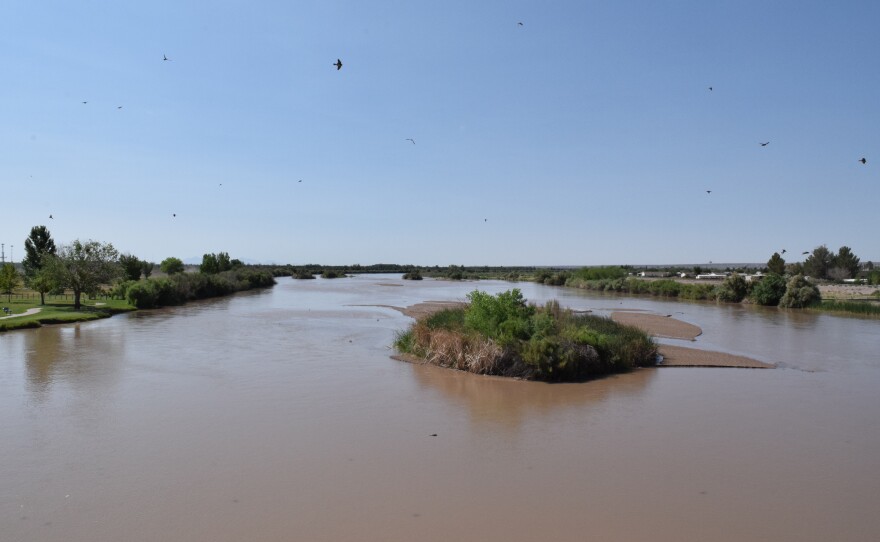
Rafael Rovirosa has deep roots in southern New Mexico.
His family has been farming in the area since before 1925 and he currently works as the Vice President at Stahmann Farms, helping to oversee one of the largest pecan businesses in the world.
“It means a lot to me. This is where I grew up, this is all I’ve known for my entire life. I have lived in other places before but I always come back and this is where I am going to spend the rest of my life,” Rovirosa said.
But for over the last decade his farming operation and many others like it had been watching a lawsuit making its way through the court system. In 2013, Texas sued New Mexico alleging that the state was pumping too much water out of the ground and breaking a nearly nine decades old compact.
After journeying all the way to the United States Supreme Court, a settlement was reached in May of 2026.
The settlement includes creating an index for how much water New Mexico has to deliver to Texas, letting New Mexico 57% of the water from the Rio Grande Project and having the state of New Mexico buy groundwater pumping rights from voluntary sellers totalling 18,200 acre-feet of water over 10 years in the Lower Rio Grande. One acre-foot is roughly 325,000 gallons of water.
Rovirosa said that he is glad that there is now certainty around water but says that there will be some negative effects for the ag community.
“There is definitely going to be an impact on the ag community. That 18,200 acre-feet, it can come out of other uses but it almost certainly won't because they won't be willing to sell for the prices that they are offering. It's going to be almost all farmers that are willing to take that price. As far as the index goes, when things are in medium to dry conditions more water is going to go to Texas. Over the long run, if we get back into wet times, then it should balance out similarly to how water was split up during the period from 1950 to 1978,” Rovirosa said.
Rovirosa also says that groundwater pumping is essential for living and farming in this area and especially for drought resilience.
“Civilizations in New Mexico have boomed and busted over the availability of water and the reason that hasn't happened in modern times despite the droughts that we have gone through is because of our access to ground water,” Rovirosa said.
The process of the state buying groundwater rights is still in its beginning stages but Ryan Serrano, Lower Rio Grande Bureau Chief for the Interstate Stream Commission, said that there is a lot of flexibility in which type of groundwater rights the state can buy.
“We can purchase really three main categories. Ground water only rights which are farmers that own rights that irrigates only with groundwater pumped out of the aquifer. We can also purchase combined rights which are farmers primarily in the Elephant Butte Irrigation District that receive surface water from the Rio Grande Project but also pumps ground water and then the third component there is we can buy other types of uses rights so think domestic, commercial, municipal, and industrial type uses. Those are 100% consumptive use so every drop they divert gets consumed,” Serrano said.
Serrano said that they are still conducting market studies to see how much those rights could be sold for but sales could begin this fall.
Serrano also said that the 18,200 acre-feet of water seems like a lot of water, but it only makes up a fraction of all water use.
“When we are comparing the 18,200 acre-feet requirement, you can think of that as the equivalent of roughly 6% reduction in current diversion amounts. So that is what we are looking to reduce by 6%. You can also think of it as how does it compare to the largest water users in the Lower Rio Grande and I will give you a couple of examples. The City of Las Cruces averages anywhere between 19,000 to 21,000 acre-feet a year and that is across their entire service area. Some of our largest irrigation users here in the valley will consume somewhere in the order of 16,000 acre-feet annually," Serrano said.
On top of the 18,200 acre-feet requirement, the state may also have to cut more groundwater pumping if there are poor hydrologic conditions in the area. If a volunteer purchase program does not produce enough sellers, other options are being negotiated.
“So under state statutes and rules and regulations there is what is called active water resource management. As part of that active water resource management, local users have the ability to establish shortage sharing plans or administrative plans and those are locally based solutions for limiting depletions in those hard times as opposed to heavy handed government intervention,” Serrano said.
“If you look at the recent flows of the river and what is sustainable for the Lower Rio Grande in New Mexico, it is a much smaller number than has been pumped historically and we can't provide Texas their share unless our use is sustainable so the river will flow,” Gaume said.
Norm Gaume, former director of the New Mexico Interstate Stream Commission and President of New Mexico Water Advocates, says that this will have much more of a major impact on the area's water supply.
“If you assume that the water supply is going to be the same as it has been for the last two decades, we have to make huge cuts. If it is worse than the last two decades and who says it's going to be any better, then those cuts become really severe. How much water do the municipalities and these institutions and the businesses and the industries that are not ag need, its not that much and the settlement has mechanisms to provide for that. But the central question is how's this going to happen and who's going to pay. What I can say is that the era of cheap and easy water supplies that's gone forever. It's going to be a whole different ballgame,” Gaume said.
Gaume says that how the region uses water is partially responsible for how the lawsuit came about. He says that under the Richardson administration in New Mexico pecan farms exploded in the Lower Rio Grande and received a special water right receiving nearly 5 acre-feet of water. Today, pecans make up around 40,000 acres of farmland in the area.
This combined with population growth in the area and a long lasting drought led to more groundwater pumping at what he says is an unsustainable rate.
“Frankly, I don't know how these issues could have been settled without the litigation. But now they have and they are final and we have an unbelievably difficult task to get things back in balance,” Gaume said.
However Rovirosa says to pin the blame on pecans for the lawsuit and less water is an oversimplification. He says that many others pump groundwater in the area as well.
“To say that it is pecan trees that are making it so we don't have enough water in the region is a false assertion. Agriculture has been using the same amount of water in the region since the 1970’s. We have not increased even though we have planted more pecan trees. The amount of water we used stayed the same. The reason we don't have water in the region is because it hasn't been snowing as much in the mountains since the early 2000’s and because it has gotten hotter. That's why,” Rovirosa said.
Rovirosa also said that there is a key difference between diverting water and depleting water.
“Water that you divert isn't necessarily removed from the region. In fact, something like 20% to 40% of the water that we divert and apply to a field soaks back down into the aquifer. That water is not lost, that water is recoverable to the region,” Rovirosa said.
Negotiations regarding the settlement are still ongoing.
