

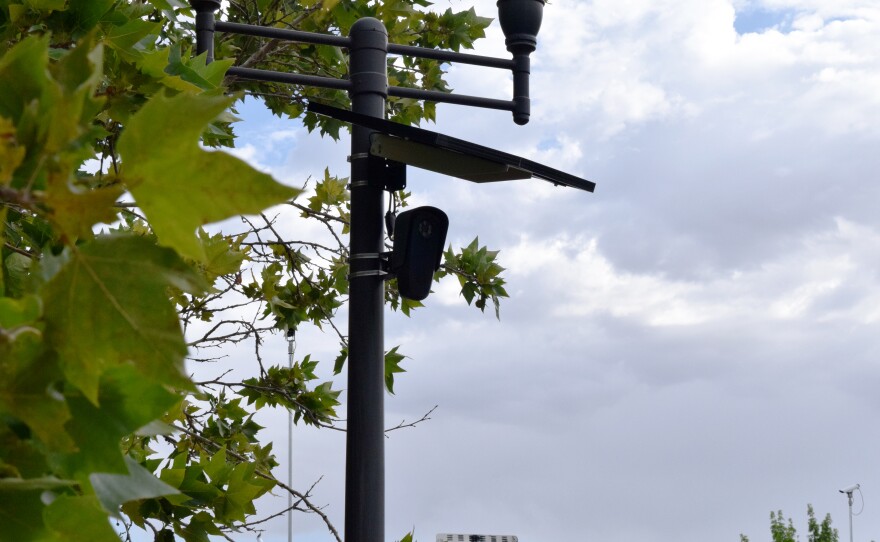

The City of Las Cruces has installed many automatic license plate readers commonly associated with Flock around the city causing many residents to speak in opposition to the cameras during council meetings. KRWG’s Noah Raess spoke with Deputy Director of Public Policy at the New Mexico Americans Civil Liberties Union Daniel Williams to learn more.
Noah Raess:
My first question is, I've been attending a lot of city council meetings recently, and Flock cameras have become kind of a point of contention among a lot of the speakers. Can you just walk me through what is kind of controversial and what have you found to be controversial about Flock cameras?
Daniel Williams:
So I think, Flock cameras and really all kinds of license plate readers, ALPR’s, they are a particularly widespread and popular form of mass surveillance and by the nature of their technology, they are capturing data on everyday people living their everyday lives and holding on to that data, regardless of whether or not that person is ever going to be suspected of or involved in a crime. I think that's really concerning because that challenges some of the fundamental notions that we have in this country, some of our fundamental traditions that we don't spy on people just in case we later want the information that we have. With Flock in particular, one of the things that is particularly concerning is the built in data sharing. And thanks to the work of our legislature and the leadership of agencies like LCPD, we have some guardrails around that data sharing now, but being able to share data widely with agencies around the state and really around the country does continue to amplify the privacy concerns associated with F Flock.
Noah Raess:
How is this data being used and is it ever being misused?
Daniel Williams:
So we know that license plate reader data can be really helpful for solving crimes, including solving serious crimes. And we don't want to take that ability away from law enforcement. We also do know that before the passage of SB 40 this year, the data was being misused. We know that thousands of times in the previous year, agencies around the country accessed New Mexican data with search terms like immigration, ICE, HSI. We also know of at least one documented instance where a sheriff's office in Texas was looking to prosecute a woman for a self-managed abortion and access to New Mexico camera data while looking for her. Hopefully, the Driver Privacy and Safety Act, which passed this year, will prevent those kinds of misuses in the future b ut, we know that there's still work to be done to protect our privacy.
Noah Raess:
This topic seems to be the perfect example of the ongoing debate between privacy and security. Recently in Las Cruces, there was a hit and run that made news, and the driver was caught with the help of Flock cameras. I'm just wondering, has it ever been defined legally where the line is between privacy and security, and where do these Flock cameras kind of fall in that range?
Daniel Williams:
So we have a rich tradition in this country of the Fourth Amendment. The idea of needing warrants to access information about us, to search our homes, to search our papers and things. The first time it was written centuries before we had things like high speed cameras and AI that could analyze the results. And so the legal question of what's a search, what's a reasonable expectation of privacy, all of those really technical questions the courts are still weighing that and still figuring out how our centuries old legal principles interact with technology that's changing, really by the day, in some cases.
Noah Raess:
Focusing on Las Cruces, I feel like I've seen this debate spike recently. How fast has this technology come onto the scene in New Mexico and Las Cruces.
Daniel Williams:
I think we know that Las Cruces has had ALPR’s for several years now, as has Doña Ana county. And we also know that the technology is getting cheaper, it's getting more available, it's getting more popular. It's being marketed very aggressively by companies like Flock. And we know that unfortunately, we don't have mechanisms in place in most communities for the community to have insight into let alone a voice into the way that that law enforcement is acquiring and implementing surveillance technology, whether that's automatic license plate readers or facial recognition or the new Real Time Crime Center. And I think that that could be a really important step to build in that transparency, give the community a voice, give the elected leadership a voice before the law enforcement implement a technology that might have significant privacy implications.
Noah Raess:
Earlier you mentioned how helpful these can be in a case in a criminal, or something on those lines. I guess how would you kind of walk the line between that privacy and allowing law enforcement to have these tools?
Daniel Williams:
Absolutely. I think, again, the ACLU doesn't have a blanket opposition to the use of automatic license plate readers. We recognize that there are important applications for public safety. And as you say, we recognize that there is a line to be walked. And so I think thinking really seriously about things like retention, how long is the data held on to after it's captured, who has access to it both within the agency and how is it shared with other agencies, what kind of offenses is it going to be used for, what audit and transparency mechanisms are in place and then what discipline that will be imposed if it's misused. I think those are all some of the important questions that we would love to see policymakers in Las Cruces bring forward.
Noah Raess:
My final question, you also mentioned some state level action that has taken place in the past. Is there any other possible state action that might be in the works or people have talked about?
Daniel Williams:
We continue to be interested, and I think there continues to be an appetite from some legislators to really look at exactly some of those questions that I just raised so that it's not justice by geography. So that's you have as much privacy in Las Cruces as you do in Farmington or Gallup or Raton. And I think that that's something that we'd love to see our state policymakers take a look at, not just in the realm of ALPR’s and Flock, but in the realm of this whole category of advancing surveillance technology.
