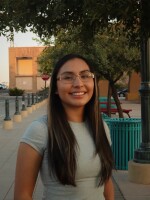
Abigail Salas:
Can you tell us about how your background has prepared you to serve as assessor?
Eugenia Montoya Ortega:
I am the current assessor. I have just started year four now in January. So, I have the three years of experience under my belt. I also, prior to becoming the assessor, well we still do, my husband and I own a small bakery on Valley Drive. So, we are small business owners. I am currently actually listed as an owner. However, I have not been to work at the bakery in the last three years because I have four years because I have been busy being the assessor. I also have experience working in HR. I worked at Mesilla Valley Hospital as well as Memorial Medical Center in HR under the direction of a wonderful director by the name of Ms. Linda Moya, who taught me a lot of information about human resources. So that I would say that those are the things that probably qualifies me, you know, honesty, integrity, Fairness, I'm about fair. I'm about following the law. That is what dictates the assessor's office, is we are dictated by the state statute. And I am a law follower.
Abigail Salas:
And why are you running for county assessor?
Eugenia Montoya Ortega:
The reason that I am running for re-election is I would like to finish what I started. When I first came in, I thought, oh, we're going to take care of this like really, really quick. Unfortunately, you hear that saying that government is slow. And I guess I didn't really take that to heart. So, it's taken time. It takes time for the staff in the office to, because it's an elected office, to get used to the next person that comes in. Because a new administration that comes in might have their way that they think things need to be done or demand that things get done their way. And so, it takes the staff a little bit of time to get used to you and then kind of see what you're trying to do and then kind of like, do they trust you? Do they not trust you? So, it takes a little bit of time. Yeah, I would like to finish what I started. Like I said, it's difficult on the staff when you have a new elected come in. So, they already know what they've had for the last almost four years, for the last 3 1/2 years. And so they know what to expect. It's not like, oh, we have a new person coming in. Now what are they going to do? Now what are they going to change? They see, have seen what they've had for the last 3 1/2 years. They know what's expected. And we're all moving in the same direction. It takes time to get everybody on the same page. And I would say for the most part, we're all there. So now it's just like, okay, taking the baton and finishing the race.
Abigail Salas:
What are the top issues in the county? How would you successfully address those issues?
Eugenia Montoya Ortega:
Currently the top issues in the county is the assessor's office is an office that actually has two budgets. We have what's called our 1% budget, and we have our general budget. However, over the last several years, those two budgets have somehow become co-mingled. So, the 1% fund, what it is, is it's 1% of all the property taxes that are collected each year, is put into a special fund for the assessor's office so it can be used for reappraisals, anything for reappraisals. Every year, our office does actually touch every account to make sure that we are within where the market wants us to be or where we should be. But this office has not had a full-blown reappraisal project, boots on the ground, since 2008. This office went through a new CAMA system, which is a computer-aided mass appraisal system that we use in our office. In 2016, there was a new software that they went to. So, when they went to that new software, the assessor at that time only brought some of the information from the old system to the new system. So, we have several outbuildings that are in the county that are not on the books because they got left behind in the old CAMA system. So, my goal is to try to get a reappraisal project done, meaning we actually hire a company, they go out there, they touch every parcel, they look at everything that is on that property that maybe is not showing up now. That is there now but wasn't showing up last year or the year before. They make sure that we pick up those parcels, then we actually have everything on the book. The big problem is, like I said, those two funds have been co-mingled. So, in order for me to do a reappraisal project, which they run several $1,000,000, we out of curiosity did a, reached out to a company like, hey, what would something like this cost? It's like $4 million. Well, I don't have my 1% budget sitting there waiting like it should be. So had I had my 1% budget, I would have approximately, we did some math, and we had kind of guesstimated like $14 million. So, if I had that $14 million account sitting there waiting, I could do a reappraisal project and get that taken care of. I have been working since I started pretty much day one with the BOCC in finance. To try to get those accounts straightened up. And to date, we haven't gotten that done. But I would say we're closer to it now than ever to hopefully getting that fixed.
Abigail Salas:
What else do you think is important for voters to know about your campaign?
Eugenia Montoya Ortega:
What I think voters should know about my campaign is me and my team I call my team here they're not my staff they're my coworkers. We've been working very, very hard to get the office to where it needs to be. State statute dictates that the assessor, as well as the other four electives in this building, we are only obligated to work eight hours a month. I have worked every day, at least eight hours a day, because to me, the majority of the job is showing up, any job, you have to show up, be willing to work. We have been here working. My staff has been on board. My coworkers have been on board. To getting the job done. They have seen the work that we have been doing, and we actually have the proof that in the last three years that I have been serving, the mill rates have come down, which are the tax rates. And the way that that works is, you know, when I first ran, I ran that I didn't believe that people were being taxed fairly. There were some people paying more than their fair share. There was people not paying their fair share. So, when I came in, we have looked at that. We're getting people that have not been paying their fair share to pay their fair share. And when that happens, then the rest of us, the mill rates will come down, the tax rates will come down. So, we've been working very, very hard. I'd like to finish what I started. Makes it easier on the staff that they don't have a new administration coming in and trying to change things. Because now you basically have four more years of trying to make things happen. We are beyond that. We've already completed almost the four years. We have now four years, like I said, to take the baton and finish the race. I'm about fair and equitable taxes. I don't believe people should pay more than they need to. But at the same time, I think everybody needs to pay their fair share. I know that they're working on through the legislation to try to. So right now, in New Mexico, we have what's called a cap law. So, anybody that owns their home, their personal residence, property taxes for their homes cannot increase more than 3%. The reason that law was enacted in 2001 was to keep people in their homes and keep them from being taxed out of their homes, especially when the market starts getting really crazy. Well, now they're trying to work with the legislation. Some of the commercial property owners that they would like to see a cap on commercial property. Well, New Mexico is a partial non-disclosure state, meaning when I sell my home, I have to disclose that on an affidavit. That information is turned into the assessor's office. It's not public information. It's information that we use to set the market. Well, when a commercial property owner sells their property, they do not have to disclose that. It's a mystery, it's a secret. They're obviously making money when they sell that property. So, it makes it really difficult to assess what their properties are truly valued. So, we use a company that kind of helps give us that information, but it's not very detailed. It doesn't specifically say like, oh, that building over there on Valley Drive or whatever. It kind of says it's a commercial property within this certain radius. So, it's not easy to find out exactly what that commercial property is listed for. So, by us putting a cap on, that is not fair because whenever you cap anything, that tax burden shifts to the rest of us. Commercial property is income-producing property, and there should be no cap on that. Because like I said, when you put a cap on something, the tax burden is shifted to the rest of the taxpayers.