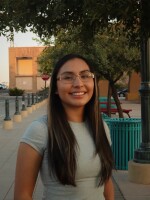
Abigail Salas:
Can you tell us about how your background has prepared you to serve as sheriff?
Vanessa Ordoñez:
I think what has prepared me for the sheriff role, I grew up right here in Doña Ana County and I'm deeply rooted in this community. I bring over 2 decades of combined military and law enforcement experience, including executive leadership and also military combat service. I did advance through the United States Navy law enforcement profession to become a senior enlisted leader, and I've served in roles that have demanded the ability to lead under pressure. I've also served overseas assignments that have really exposed me to diverse cultures, and I've worked with people of all different backgrounds. Let's see, in 2010, I became a New Mexico law enforcement officer. I began my local law enforcement career right here in Doña Ana County with the Sheriff's Office. And I served as a patrol deputy, field training officer, crisis negotiator, and also a police instructor. That experience gave me a strong foundation in local policing and a clear understanding of the challenges that our community faces pretty much every day. Another thing is I do hold a master's degree in criminal justice administration. And more recently, I served as chief of police for the city of Anthony, where I was responsible for personnel and operations. During my tenure there, the city was recognized as the safest city in New Mexico just last year, which I take a lot of pride in. I do continue to grow as a leader through executive training programs. And I'm also a certified mental health and domestic violence instructor. I do serve on multiple boards that are focused on criminal justice and victim advocacy. And then, I mean, other than that, I do continue to serve our country with an expeditionary warfare qualification. And I have supported the Navy with embarked security operations in international waters. I've participated in overseas community relation efforts. And one thing I also take pride in is supporting an orphanage in Ghana that serves young girls who were victims of sex trafficking. So, I think all of my past experiences have really prepared me for this role.
Abigail Salas:
Why are you running for sheriff?
Vanessa Ordoñez:
I am running for sheriff because I think, I mean, for me here, I've dedicated my life to service and protecting this community already. I believe that Doña Ana County really deserves experience and forward-thinking leadership. I think they deserve someone who's creative, innovative, and also committed to moving the office forward. Like to many families, I mean, this is home. I've seen both the strengths of the community and the challenges that we face, especially as it relates to juvenile crime, mental health issues, substance abuse. And I really think that these issues require steady leadership. I also believe that it's important to recognize and build upon the positive work that has already been done at the sheriff's office. There are dedicated men and women who have been serving every day, and I think that they've tried to make efforts to improve the overall operations of public safety there. I do intend to continue building on those strengths and also expand on them through consistent, clear direction, basically. With my experience, I understand, what it takes to lead a complex organization and make decisions under pressure. I've served locally in Doña Ana County and the Navy and also, like I said, most recently as the chief of police. And I feel like I'm running too because law enforcement really must stay connected to the community it serves. And I'm prepared to continue leading and also delivering results to the county.
Abigail Salas:
What are the top issues in the county and how would you successfully address those issues?
Vanessa Ordoñez:
So, from what I have seen, I think the top issues in Doña Ana County, they include juvenile crime and of course, mental health related calls. At the same time, I think there are broader challenges that we also have to face, like limitations on resources and also how the coordination is between agencies and also how we're delivering that service across the county, including the rural communities. I think to address these issues, I believe the solution starts with a really strong collaboration and clearly defined roles between the sheriff's office, the county commission too, and also the community stakeholders. I also believe that public safety cannot be solved by just one agency alone. It really takes a whole unified approach. One of my priorities would be to strengthen the collaboration with the county commission so that everybody's aligned on the priorities and what those strategies mean to everyone. That can be accomplished by regular communication, shared problem solving, and also ensuring that the resources, you know, are basically directed to where they are needed. And I also think it's important to maintain a clear separation of responsibilities the commission provides oversight while the sheriff's office is responsible for the actual law enforcement operations. When those roles are clearly respected and they're understood, I think it improves effectiveness overall. Internally, I would focus on strengthening the partnerships with community organizations, our service providers, and of course, our law enforcement agencies across the county. Issues like addiction, mental health crisis, I think are really top priority and juvenile crimes. And I don't think they can be solved alone. They really require everyone working together.
Abigail Salas:
Technology is rapidly advancing the footprint of law enforcement. What technology that exists now in DASO would you expand upon, and what new areas would you develop?
Vanessa Ordoñez:
So, technology is key in law enforcement, and I think that it really plays a major role, especially in modern policing. I believe that the sheriff's office must continue evolving in ways that are enhancing officer safety, transparency, and public trust. What I would do is I would continue expanding those technologies that improve operations and accountability, such as like the body worn cameras, the in-car camera systems, and then real-time data sharing, I think, is huge, too, and also stronger interoperability between agencies so that communication is streamlined well. I also believe that, you know, we should constantly be exploring what other elite agencies are doing across the country and also identifying evidence-based technologies so that maybe we can realistically bring that back to the county to improve our service delivery. I also believe there's an opportunity to always improve our technology through dispatch patrol investigations, through data-driven policing. And at the same time, technology, I think, must be implemented responsibly. I think there should be always policies, training, and also enhanced cybersecurity measures in place. I feel that technology can definitely be used as a force multiplier as well. I don't think it should be intended to replace good policing, but to support smarter policing.
Abigail Salas:
The training budget for DASO is about $100,000 a year. Would you expand or contract it and why?
Vanessa Ordoñez:
Well, for as many deputies and civilian staff that they have, I clearly don't think that that's enough. I would definitely look at expanding that training budget strategically, because I got to say that training is one of the most important investments that an agency can make. I think that training directly impacts officer safety, liability, of course, and reducing liability and overall service to the community. I also think that, you know, deputies are expected to handle very complex situations like mental health, crisis intervention, and they need to be equipped with the right tools and training to be able to respond and again, like provide that quality service to our community. If we expect our people to perform at a high level, then we must provide them with that training to succeed. Another thing too is, I mean, we also have to be mindful and like fiscally responsible, if we're gonna add more funding to the training, we have to make sure that, you know, we are exploring partnerships or grants and also regional collaboration so that it's not a strain on the taxpayers. I believe training should not only focus on tactical skills either. I think it should also be focused on leadership development and also officer wellness. I also believe that stronger training, it creates stronger deputies and their stronger leadership. And I think ultimately you make a stronger sheriff's office. So, for me, I don't think that training is an expense. I think I see it more as an investment in public safety. and also, a long-term organizational success. So yes, absolutely, this needs to be expanded strategically.
Abigail Salas:
What role in budget preparation, presentation, and monitoring do you see yourself in DASO?
Vanessa Ordoñez:
I already have experience in managing A multi-million-dollar budget at a police department, and I'm familiar with the Department of Finance and Accounting processes with the state, procurement requirements, and also state contracts. So, I think that experience has really given me a full understanding, or at least a reasonable understanding of what financial oversight and compliance means. To my understanding, DASO currently operates on about a $41 million budget. And I think that those funds need to be managed responsibly. Taxpayers, again, like I said, they expect accountability, and every dollar should support those public safety priorities. So, my role would be really to work closely with command staff and the finance personnel to ensure that the budget aligns with the agency's operational needs and the goals. And I believe that if I were to take office, I would make sure there is a full inventory audit of equipment, police vehicles, contracts, and other, maybe other recurring funding sources and expenses so that I'm well aware of what I have to work with in my term if elected. So that includes, you know, just monitoring all those expenditures and ultimately, I see this as a role of being a responsible steward of public resources.
Abigail Salas:
And what else do you think is important for voters to know about your campaign?
Vanessa Ordoñez:
What I think is important for voters to know about my campaign is I grew up here in Doña Ana. This is my home and I really care deeply about where we are headed. I'm not running for sheriff for a title by any means. I'm not. I'm running because I refuse to see this county go backwards. I want to see it continue to succeed. I have over 2 decades of, like I mentioned, of service in the military and law enforcement, including here, local experience in the county. And I have the leadership at the executive level already. So, for me, I understand what it takes to build and sustain a strong organization. So, what matters most to me is this, we can't lose the progress that has already been made. Like I mentioned earlier, there's dedicated men and women that are serving the sheriff's office right now. And there are already positive efforts in place that, are that basically need to be strengthened and not dismantled. My focus is to build on what's working and keep moving forward. And I don't want to take the county backwards. I want to move it forward with the experience and the commitment to the people of Doña Ana County.