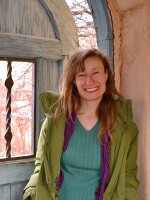
Connie Voisine is professor of creative writing at NMSU, where she has been teaching graduate and undergraduate students the art of writing poetry for 25 years. She announced her retirement this spring. She spoke with KRWG host Susan Morée about what's next for her and what advice she gave to her students over the years. This is a transcript of their conversation.
Susan Morée:
So Connie, you're getting ready to retire, but you've been a professor teaching poetry writing at NMSU for how long?
Connie Voisine:
I've been teaching 25 years.
Susan Morée:
And what are you going to miss the most?
Connie Voisine:
Our students by far, you know, they're just, I've always enjoyed working with our students at NMSU because I feel that they come from so many different backgrounds. There's a lot of first-generation college students, which I was a first-generation college student myself. And I grew up on a border, just the northern border with French Canada. And so this, I just always felt pretty at home here, you know?
Susan Morée:
And do you have any special memories that you can share of your time as a professor?
Connie Voisine:
Well, I feel that the MFA program has gone through a lot of changes over the years, but necessarily because what students want and need always changes, right? But I will say that, you know, students who've gotten MFAs at NMSU have been, they've published over 30 books so far. I've been keeping track.
Susan Morée:
Wow.
Connie Voisine:
Yeah, and each one is a huge celebration, right? We bring them to campus to launch their books. And, you know, when I first started that, I promised people, if you go get a book published, you can have a reading here, you know, we'll celebrate it right here. And now I would say almost 50% of our series is graduates of NMSU. So yeah, and they've won national book, you know, prizes and recognition internationally, too. So, it's been a really, that's just a wonderful thing to celebrate with them. Like every time one of those books comes out, I'm just pleased. Very pleased.
Susan Morée:
That's really impressive.
Connie Voisine:
Yeah, it's been, you know, some of them have gone on to be professors or teachers. Another thing I'd like to celebrate about my career here is that a student I had right when I got here, and he graduated three years later from our MFA program, is Las Cruces poet Tim Staley, and he's been teaching at Organ Mountain High School. Since he graduated, he has really just created a successful poetry program over there. And he brings students to the National Poetry Out Loud competition in Albuquerque, and he's just done very well. And so, again, I'd like to give him a shout out. It's something to be really glad about.
Susan Morée:
And what sort of, can you share some tips that you used to share with your students for those who are interested in poetry? What do you tell them? Do you give any sort of, is there a big piece of advice that you tend to give every year about how to write poetry?
Connie Voisine:
Well, first of all, you know, it is a lifestyle, right? You can do it anywhere and you don't need a lot of money, so these are all very good things about poetry. And it's a long game, too. You can do this till, you don't need like a strong back to do this. You don't need great eyesight to do this. You can do this, you know, for decades. So, if you think of it as the long game, and the more you write, the better you'll get.
Susan Morée:
And are there any sort of exercises that you would do to help your students get better?
Connie Voisine:
Well, the first exercise is I got them to read a lot of poetry, and then try to see if you can't imitate some aspect of that poem, the poem, a poem that really moves you, then you're going to try and, again, learn from that poem, and apply it to your own life, and see what you can duplicate about it. Because each poem is sort of like, I always say, it's sort of like building a chair, you just got to see how it's made. And eventually, you'll get where you can make a chair or anything if you start looking at it carefully and seeing how it's made. So, my advice is through your own reading, you'll discover what you want to and hope to achieve. And that's the way to go.
Susan Morée:
And who are some of the writers who have inspired you over the years?
Connie Voisine:
Well, you know, one of the most important things I feel that has moved and changed me as a writer, the writers I meet and know and members of my community here, like poet Joe Somosa, who's one of the people who started the program here at NMSU. He became a friend and his work always is just fascinating to me. Sheila Black, who just read here, I remember when I first moved to Las Cruces. I was like, well, who are the other poets here? And someone told me like, well, Sheila Black is a poet. And so, you know, 25 years ago, I came to Las Cruces and called her up. And we've been friends ever since. And so those kinds of connections are really the ones I learned from, I continue to learn from. I think, and I hope I do that for them, that we keep recommending books, we keep talking about poems, about sort of what we hope for our poems, and support each other through that.
Susan Morée:
And what's next for you?
Connie Voisine:
Well, I have a translation from a Togolese poet, Patron Heneku. And I need to finish that up. That's been on the back burner for a while. And I just feel like I have books left to write. And I'll start by finishing that one.
Susan Morée:
And will you stay in Las Cruces?
Connie Voisine:
Yeah, I mean, it's hard to beat the winters here, let's be honest.
Susan Morée:
That's right.
Connie Voisine:
And there are some really great, you know, there's a wonderful poetry scene right here that you know, will help support me in my writing, continue to, so.
Susan Morée:
And what's next for the department? Can you talk about that at all?
Connie Voisine:
Well, you know, I know that a temporary replacement for me will be hired, and they'll do a search. And I think that the, you know, the poetry program's in great hands with my colleague, Richard Greenfield. And he gets to make some important choices, with what's ahead for poetry at NMSU. So it’s in capable hands.
Susan Morée:
And I imagine it's going to be kind of hard for you to leave. You've been here 25 years.
Connie Voisine:
Yes, I think it will be. It is already. Thinking about it I have very mixed feelings, and I'm happy, sad, and so I cycle through all that. So, I will be. I feel that it was a very good place for me, and I'm very grateful to NMSU for that.
Susan Morée:
All right. Well, thank you so much, Connie. I appreciate your taking the time.
Connie Voisine:
Okay, thanks so much, Susan.