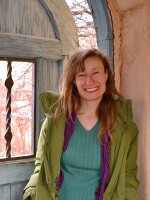
Brandon Hobson (Cherokee Nation), associate professor of creative writing at New Mexico State University, talks with Susan Morée about his latest novel, The Devil Is a Southpaw. This is a transcript of their conversation.
Susan Morée:
The book is set in Oklahoma and it's a story of two boys who are in a juvenile detention facility. What inspired you to write about this?
Brandon Hobson:
I wanted to write something ambitious that would use my original art as part of the narrative and part of the story. So, the book is about art. It's also about juvenile incarceration and envy and jealousy among two artists. I wanted to write something challenging and hopefully fun because I like challenging novels. I like difficult novels to read. And this is also kind of a highly literary novel because it references certain other books such as James Joyce's Ulysses, Milton's Paradise Lost, Dante's Inferno, And so, part of me being an English major when I was younger and now teaching creative writing, you know, I'm a lover of books and of novels. And so part of the fun of writing this book was hopefully putting all kinds of clues and literary references in them.
Susan Morée:
I was really impressed by the writing of the novel. For instance, there was a description of juvenile detention, and it says it's a brothel of rules, and I was really struck by that. What an amazing way to describe juvenile detention.
Brandon Hobson:
The narrator, Milton, is very, he's an unreliable narrator, and his sanity is questionable throughout the telling of the book. He's also trying very hard to use difficult vocabulary and obscure language to write this story in a very embellished way and try to make it a kind of type of literary novel that would be challenging, much in the way that some of the best books and literature are challenging. And so his turns of phrases throughout the book are very strange, and it's basically him trying to make it his own thing.
Susan Morée:
I couldn't help but think back as I was reading the book to all the terrible things that happened to Native Americans, particularly the boarding school experience. Was that in any way an inspiration?
Brandon Hobson:
That was a big part of it, yeah. I was thinking about a lot of the residents being Native American and being in a situation. There's a lot that's been written about residential schools for Natives. And I wanted to do something a little bit different that still kind of references the way that Natives were treated in a different kind of setting. And so juvenile incarceration definitely was an inspiration to do that. I was also a social worker for seven years before I went on to graduate school and got a PhD. And so one of my jobs in social work was working with incarcerated youth.
Susan Morée:
One thing I was struck by in the book is thatthere are two characters, Milton Muleborn and Matthew Achoda. And at times I was not certain who was who. But, and I think that was probably intentional?
Brandon Hobson:
Yeah, that's, well, Milton is the narrator, right? He's written this first part of the book. And so, part of his aim is to try to say that he's as good of an artist as Matthew Echotawas, and that in some ways, maybe he's even a better writer, and he's trying to write this story using all these very absurd images of being locked up and of art, using his artwork as a narrative device. So, it was really fun to write this book through the lens of this character. And it's much, I tell students, it's much in the way of like acting where you're inside the head of a character and you're kind of telling a story. And so that's part of the fun, I think, especially of writing a first-person narrative.
Susan Morée:
And one thing I was struck by is one of the characters is Cherokee and one of the characters is white.
Brandon Hobson:
Correct, yeah. Part of the reason Milton Muleborn is writing this is a kind of jealousy toward Native Americans, and especially the art that, and the artist that Matthew Echota has become. So as a non-Native person, he's kind of displaying a strange type of racism here by showing enviousness. It's admirable in some ways the way that he sees it, but he's also being, he's very mean. He's a kind of strange and mean cryptic narrator.
Susan Morée:
It struck me as perhaps a larger metaphor for the complexities that exist around Native Americans in the way that as, culturally, we have treated Native Americans.
Brandon Hobson:
Right. Yeah, that's part of it. I mean, that's not a huge part of the book. I'm more concerned with this idea of, you know, the sin of envy and pride that Milton is suffering, and he's trying to show and use his art as a way to say, hey, I'm as good as this person was.
Susan Morée:
It also felt to me that your novel is a conversation with other novels and novelists from the past, such as Paul Auster, who wrote City of Glass and had characters who were named Paul Auster. You have a character in your book named Brandon Hobson. And then also with Vladimir Nabokov and perhaps Fyodor Dostoyevsky, because there's a lot of doubling going on. Can you talk about that?
Brandon Hobson:
Yeah, those are all big influences on me. Dostoyevsky, Nabokov, specifically, Nabokov wrote and used a lot of unreliable narrators in his fiction, especially books like Pale Fire and Pnin. These are novels that were a big influence on me. Certainly Dostoyevsky's doubling is a big influence on me. In fact, Nabokov used some doubling as well in his work. And so part of this being, it could even be considered kind of a, you know, a postmodern novel in some ways, in that it's fracturing narrative, using these devices in an attempt to question what reality is for these characters.
Susan Morée:
Is there anything else that I haven't asked you that you think I should have?
Brandon Hobson:
I hope that by the end of the book that it's kind of redemptive and that the reader feels a little bit of empathy for a narrator like Milton Muleborn, who is so damaged and so, at least early on, full of anger and envy. My hope is that the bookshows some redemptive qualities in him.